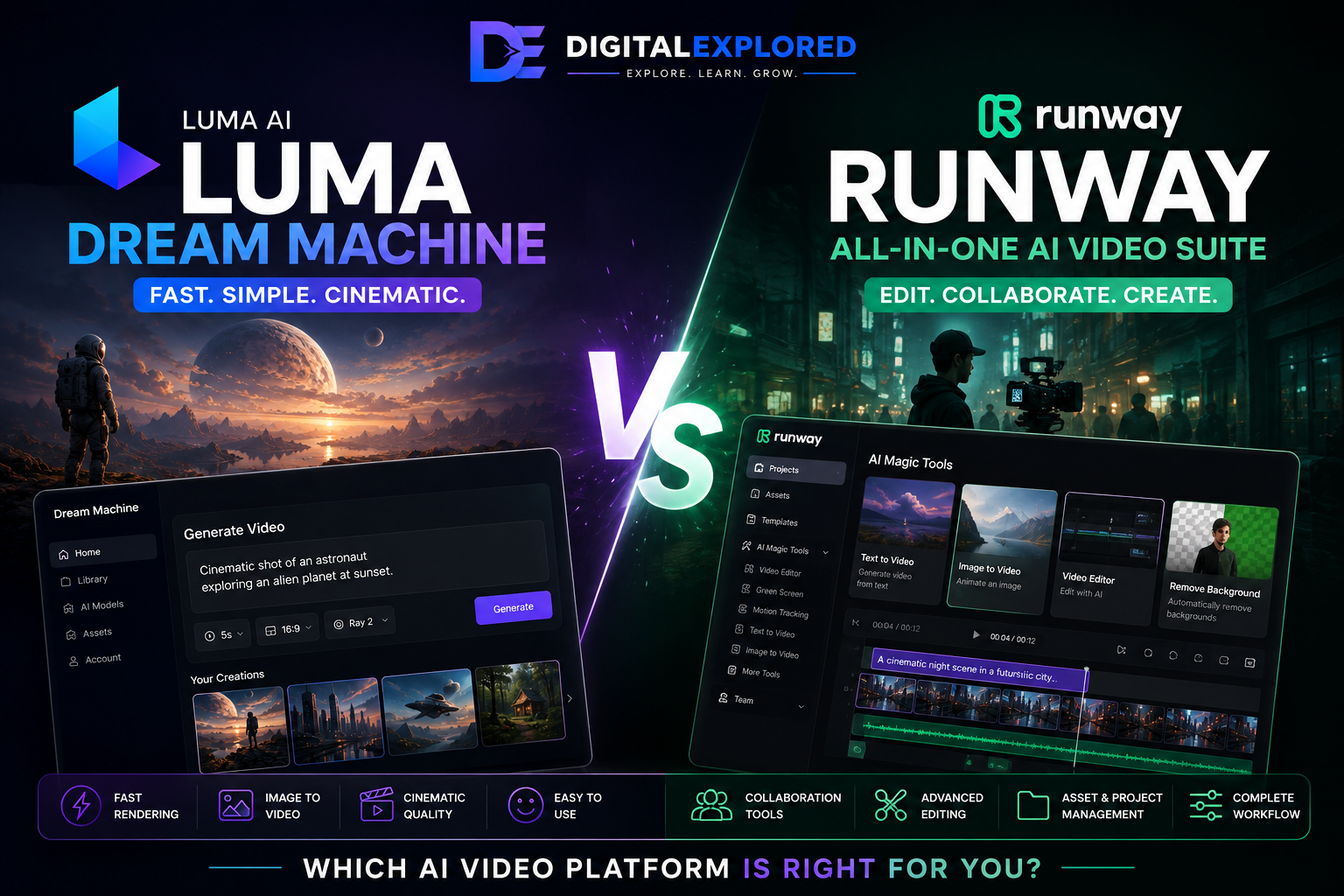
Luma Dream Machine vs Runway is one of the most common comparisons among creators looking for an AI video platform, but despite competing in the same space, these tools are designed with very different priorities. Both can generate impressive AI videos from text prompts and images, yet the experience of using them—and the type of creator they suit best—varies considerably.
Luma Dream Machine is built around a simple idea: generate cinematic AI videos as quickly as possible with minimal friction. Its streamlined interface, rapid rendering, and exceptional image-to-video capabilities make it an appealing choice for creators who want to move from concept to finished footage without navigating a complex production environment.
Runway takes a much broader approach.
In addition to high-quality AI video generation, it offers AI-powered editing, object removal, collaboration tools, project management features, and workflow enhancements that make it feel more like a complete production suite than a standalone AI generator.
That difference—generation-first versus production-first—is what defines this comparison.
Neither platform is objectively better.
The right choice depends on how you create content, which features you actually use, and whether your biggest priority is producing cinematic visuals quickly or managing an entire production workflow inside one application.
In this comparison, we’ll explore:
- AI video generation quality
- Image-to-video performance
- Rendering speed
- AI editing capabilities
- Ease of use
- Workflow differences
- Collaboration features
- Pricing
- Overall value
- Which platform is best for different types of creators
Rather than simply comparing feature lists, the goal is to help you decide which platform fits naturally into the way you already work.
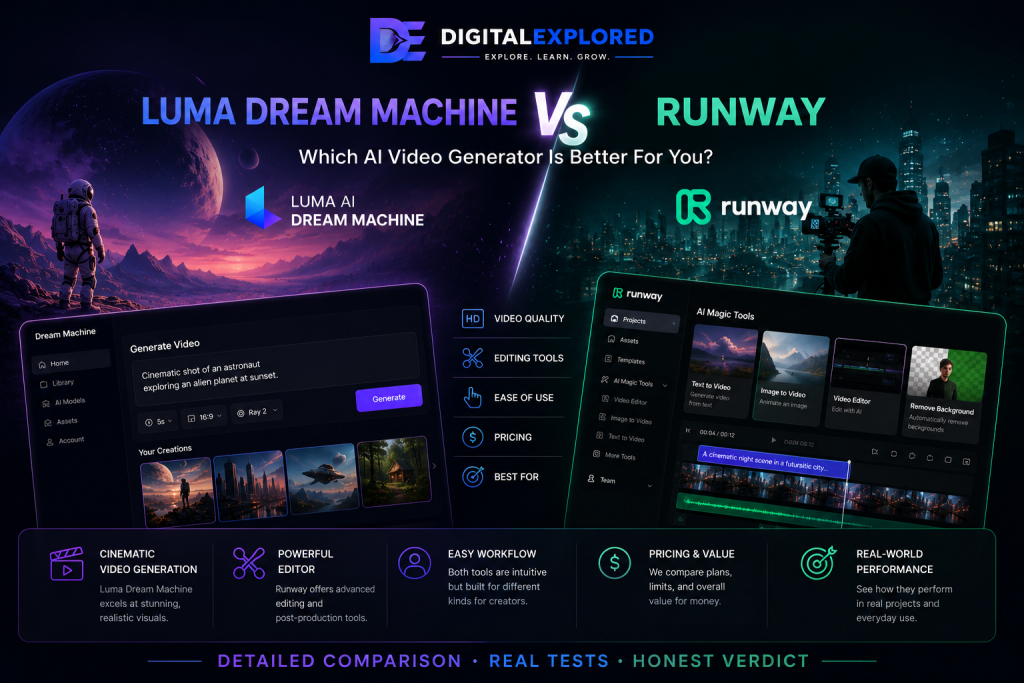
What Is Luma Dream Machine?
Luma Dream Machine is an AI video generation platform developed by Luma AI, a company well known for its work in computer vision, neural rendering, and photorealistic scene reconstruction.
Long before entering the AI video market, Luma AI built its reputation through research into technologies such as Neural Radiance Fields (NeRF). That expertise eventually evolved into Dream Machine and the proprietary Ray family of AI video models that power it today.
Unlike many creative platforms that try to cover every stage of video production, Dream Machine focuses almost entirely on creating visually impressive AI-generated footage with as little complexity as possible.
Its browser-based workflow allows users to:
- Generate videos from text prompts
- Animate existing images
- Experiment with multiple creative ideas quickly
- Download finished clips for editing elsewhere
Instead of overwhelming users with editing panels and production tools, Dream Machine emphasizes three core strengths:
- Speed
- Simplicity
- Visual quality
That focused approach makes it especially appealing to creators who already have an editing workflow and simply need an efficient way to generate original AI footage.
Some of the platform’s standout characteristics include:
- Creator-first design
- Browser-based workflow with mobile access
- Cinematic AI video generation
- Excellent image-to-video performance
- Fast rendering
- Continuous improvements through Luma AI’s Ray models
Rather than replacing traditional editing software, Dream Machine aims to become the fastest route from an idea to a polished AI-generated clip.

For affiliate marketers, YouTubers, designers, entrepreneurs, and content creators, that often means spending less time navigating software and more time exploring creative ideas.
What Is Runway?
Runway is an AI-powered creative production platform developed by Runway AI.
Although it includes many of the same AI video generation capabilities as Dream Machine, its overall philosophy is much broader.
Instead of focusing solely on generation, Runway is designed to support much more of the production process.
Alongside text-to-video and image-to-video generation, it includes:
- AI-assisted editing
- Object removal
- Masking
- Motion tracking
- Video transformation
- Collaboration tools
- Project management
- Asset organization
Rather than exporting a generated clip into another application, creators can continue refining their work without leaving the platform.
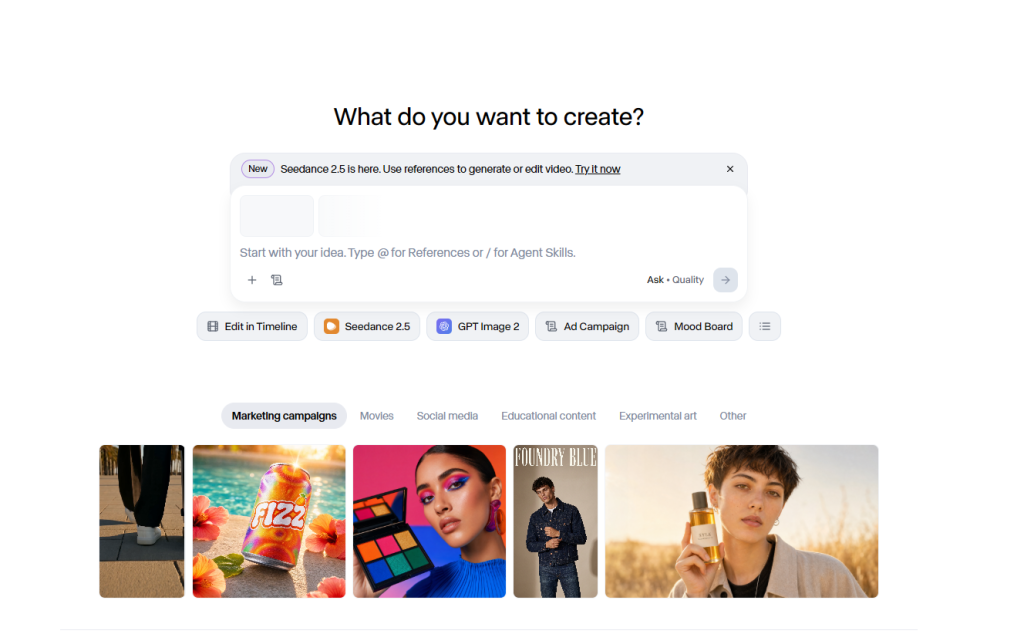
Runway’s workflow is built around helping users:
- Generate AI footage
- Edit videos
- Transform existing footage
- Organize creative assets
- Collaborate with teammates
- Manage production projects
- Export completed work
Because of this broader feature set, Runway appeals particularly strongly to:
- Agencies
- Production teams
- Marketing departments
- Professional creators
- Businesses managing multiple creative projects
Its primary strengths include:
- Extensive AI editing tools
- Browser-based production workflow
- Collaboration features
- Project organization
- Integrated creative environment
- Frequent platform updates
The trade-off is complexity.
Compared with Dream Machine, Runway includes many more capabilities, but naturally comes with a steeper learning curve and a workflow that may feel excessive if your only goal is generating AI videos quickly.
Luma Dream Machine vs Runway: Quick Comparison
| Category | Luma Dream Machine | Runway |
| Best For | Fast cinematic AI video generation | End-to-end AI production workflows |
| Ease of Use | Excellent for beginners | Better suited to experienced users |
| AI Video Quality | Excellent cinematic output | Excellent with integrated editing |
| Image-to-Video | Outstanding | Excellent |
| Rendering Speed | Excellent for rapid iteration | Strong, workflow-focused |
| AI Editing | Basic | Extensive |
| Collaboration | Limited | Excellent |
| Workflow | Generation-first | Production-first |
| Browser Experience | Excellent | Excellent |
| Mobile Support | Mobile app available | Primarily browser-based |
| Commercial Use | Available on eligible paid plans | Available on paid plans |
| Best Choice For | Individual creators and marketers | Teams, agencies, and production workflows |
The table provides a useful overview, but it doesn’t tell the whole story.
Runway clearly offers more advanced editing features, but that doesn’t automatically make it the better platform. If your workflow already revolves around software such as Adobe Premiere Pro or DaVinci Resolve, those built-in editing tools may provide relatively little additional value.
Likewise, Dream Machine’s streamlined interface isn’t simply easier to learn—it also enables much faster creative iteration for users who mainly care about generating high-quality AI footage rather than managing an entire production pipeline.
The remainder of this comparison looks beyond feature lists to explain why these differences matter depending on the way you create content.
Luma Dream Machine vs Runway Feature Comparison
Comparing these platforms isn’t just about counting features.
Both can generate AI videos from text prompts and animate still images, but the experience of using those capabilities is very different.
Dream Machine is built to remove as much friction as possible between an idea and a finished AI-generated clip.
Runway is designed to help creators manage the entire production process—from generation to editing and collaboration.
Let’s break down the major categories.
AI Video Generation
For most creators, generation quality is still the deciding factor.
If an AI platform can’t consistently produce impressive footage, its other features become far less important.
Fortunately, both Dream Machine and Runway rank among the strongest AI video generators currently available.
The difference lies in how they approach the creative process.
Luma Dream Machine
Dream Machine is powered by Luma AI’s proprietary Ray models, which prioritize cinematic visuals, realistic movement, natural camera motion, and fast rendering.
Instead of trying to become an all-in-one creative suite, the platform focuses on generating footage that creators can quickly incorporate into larger projects.
Its biggest strengths include:
- Cinematic lighting
- Smooth camera movement
- Strong prompt understanding
- Excellent short-form video generation
- Rapid creative iteration
That makes it especially appealing for creators producing YouTube B-roll, marketing videos, concept animations, and promotional content.
Runway
Runway’s Gen models also produce high-quality AI videos while taking a broader production-focused approach.
Its strengths include:
- High-quality AI-generated footage
- Continuous model improvements
- Flexible prompt interpretation
- Strong commercial usability
- Tight integration with editing workflows
Unlike Dream Machine, Runway doesn’t rely solely on getting the perfect generation immediately.
Instead, creators can continue refining the footage using the platform’s integrated editing tools.
If you’re considering other high-end AI video models, our Google Veo vs Runway comparison looks at how Runway performs against Google’s video generation platform.
Which Platform Performs Better?
Both platforms generate outstanding AI videos.
Choose Luma Dream Machine if you value:
- Fast cinematic generation
- Minimal workflow complexity
- Rapid experimentation
- High-quality visual concepts
Choose Runway if you value:
- AI generation as part of a complete production pipeline
- Integrated editing
- Greater creative flexibility
- Long-form commercial workflows
For independent creators, Dream Machine often feels faster and more intuitive.
For larger teams, Runway’s integrated production environment can provide greater long-term efficiency.
Image-to-Video
Image-to-video generation has become one of AI video’s most valuable capabilities, particularly for affiliate marketers, ecommerce businesses, designers, and content creators.
Instead of creating a scene entirely from text, creators can animate existing images into engaging videos.
This is one of Dream Machine’s strongest competitive advantages.
Luma Dream Machine
Dream Machine excels at animating:
- Product photography
- Character concepts
- Illustrations
- Artwork
- Marketing assets
- Ecommerce imagery
For affiliate marketers, this dramatically reduces the need for original video footage.
Rather than filming multiple product angles, creators can transform existing product images into engaging promotional videos for landing pages, YouTube reviews, social media, and advertisements.
Designers also benefit from being able to animate artwork and branding concepts without using traditional animation software.
Runway
Runway also offers excellent image-to-video generation.
Its advantage lies in how those generated clips integrate into the wider editing workflow.
Instead of exporting videos immediately, creators can continue editing, refining, and combining footage inside the same project.
Common workflows include:
- Marketing campaigns
- Commercial advertising
- Product demonstrations
- Client work
- Social media production
For agencies and production teams, this seamless transition between generation and editing can significantly improve efficiency.
Which Platform Performs Better?
If your workflow revolves around creating videos from existing images—particularly for ecommerce, affiliate marketing, branding, or product promotion—Dream Machine has the advantage.
Runway remains highly capable, but its greatest strengths appear after generation as part of a larger production workflow.
Winner: Luma Dream Machine
Rendering Speed
Rendering speed doesn’t always get the attention it deserves, but it has a direct impact on how enjoyable—and productive—an AI video platform is to use.
Creating AI videos is rarely a one-shot process. Most creators experiment with multiple prompts, tweak camera movements, adjust scene descriptions, and regenerate clips several times before landing on the result they’re looking for.
The faster those iterations happen, the faster creative ideas take shape.
Luma Dream Machine
Fast rendering is one of Dream Machine’s biggest strengths.
The platform is built around rapid experimentation, allowing creators to test multiple prompts and visual ideas without spending long periods waiting for each generation.
That speed is especially valuable for:
- Social media creators publishing frequently
- Affiliate marketers producing promotional assets
- Designers exploring multiple creative directions
- Entrepreneurs building marketing campaigns
Instead of waiting several minutes between every attempt, creators can quickly compare different concepts, refine prompts, and move on to the next idea.
The result is a workflow that feels fluid rather than interrupted.
Runway
Runway also offers strong rendering performance, but speed isn’t the platform’s primary focus.
Rather than optimizing exclusively for rapid generation, Runway emphasizes keeping the entire creative process inside one workspace.
Once a video has been generated, creators can immediately:
- Edit footage
- Remove unwanted objects
- Apply AI enhancements
- Organize project assets
- Continue production without exporting files
Because so much of the workflow remains inside the platform, Runway often saves time in other areas, even if its overall philosophy places less emphasis on raw rendering speed.
Which Platform Performs Better?
Rendering speed only matters if it improves your overall workflow.
If your creative process involves generating lots of short clips and experimenting with prompts, Dream Machine’s rapid iteration provides a clear productivity advantage.
If your projects naturally involve editing, revisions, and collaboration, Runway’s integrated production environment may ultimately save more time despite focusing less on generation speed itself.
Winner: Luma Dream Machine
AI Video Editing
This is where the biggest differences between the two platforms begin to emerge.
Although both can generate impressive AI videos, they have very different ideas about what should happen after that generation is complete.
Dream Machine is designed to produce high-quality footage that creators can export into their preferred editing software.
Runway is designed to keep as much of the production process as possible inside its own platform.
Understanding that distinction is one of the most important parts of choosing between them.
Luma Dream Machine
Dream Machine includes only basic editing functionality.
After generating a clip, creators can review it, regenerate if necessary, and download the finished video.
The platform deliberately avoids trying to become a traditional video editor.
Instead, most users complete their projects in dedicated editing software such as:
- Adobe Premiere Pro
- DaVinci Resolve
- Final Cut Pro
- CapCut
- Other professional editing applications
For many creators, that’s not a drawback.
If you already have an established editing workflow, Dream Machine simply becomes another tool that generates high-quality footage for your existing production pipeline.
Its philosophy is straightforward:
Generate exceptional footage first. Edit later.
That focused approach keeps the interface simple while allowing Luma AI to dedicate its development efforts toward improving generation quality rather than recreating editing features that already exist elsewhere.
Runway
Editing is one of Runway’s defining strengths.
Instead of stopping after generation, the platform allows creators to continue refining their projects using a wide range of AI-assisted editing tools without ever leaving the browser.
Its editing toolkit includes features such as:
- AI object removal
- Background removal
- Motion tracking
- AI masking
- Video transformations
- Frame interpolation
- Subtitle generation
- Asset organization
- Timeline-based editing
Because these capabilities are built directly into the workflow, creators can move seamlessly from generation to refinement without constantly exporting files between different applications.
For production teams handling multiple revisions or client feedback, that integrated workflow can dramatically improve efficiency.
Which Platform Performs Better?
This category has a clear winner.
If editing plays a significant role in your workflow, Runway offers substantially more functionality than Dream Machine.
Dream Machine intentionally avoids competing with dedicated editing software.
Runway embraces that role.
That doesn’t necessarily make Runway the better purchase for everyone, though.
Creators who already rely on Premiere Pro or DaVinci Resolve may receive relatively little benefit from Runway’s built-in editing because much of that work would happen in their preferred software regardless.
Winner: Runway
User Interface and Ease of Use
Even the most advanced AI models lose their appeal if the software surrounding them is frustrating to use.
Fortunately, both platforms provide polished browser experiences, although they’re clearly designed with different users in mind.
Luma Dream Machine
Dream Machine is intentionally minimalist.
Most users can begin generating videos within minutes of signing in.
The workflow is refreshingly simple:
- Enter a prompt or upload an image.
- Adjust the available generation settings.
- Generate a video.
- Review the results.
- Download or regenerate.
That’s essentially the entire experience.
Instead of filling the interface with advanced menus and production tools, Dream Machine keeps your attention focused on the creative prompt itself.
That simplicity provides several benefits:
- Extremely fast onboarding
- Minimal learning curve
- Easy experimentation
- Rapid prompt iteration
- Low cognitive load
For independent creators, marketers, and entrepreneurs, spending less time learning software often means spending more time creating content.
Runway
Runway naturally presents a more complex interface.
Not because it’s poorly designed, but because it includes significantly more functionality.
Beyond AI generation, creators also have access to:
- Project management
- Editing tools
- AI transformations
- Asset libraries
- Collaboration features
- Multiple production workflows
There’s simply more to learn.
The payoff is that once creators become comfortable with the platform, it becomes a highly capable environment for managing larger creative projects.
Learning Curve
The learning curves reflect each platform’s philosophy.
Dream Machine
- Beginner-friendly
- Fast onboarding
- Simple navigation
- Prompt-focused workflow
Runway
- Moderate learning curve
- Larger feature set
- More production options
- Better suited to experienced creators
Neither platform is difficult to use.
The real question is whether you actually need everything Runway offers.
Many creators don’t.
Which Platform Performs Better?
If ease of use is your top priority, Dream Machine comes out ahead.
Its interface is one of the cleanest and most approachable in the AI video space, allowing users to spend more time creating and less time navigating menus.
Runway remains an excellent platform, particularly considering how many capabilities it includes, but that naturally comes with additional complexity.
Winner: Luma Dream Machine
Workflow Comparison
A platform’s feature list only tells part of the story.
The bigger question is how those features fit into your everyday creative process.
Some creators simply want to generate a few high-quality clips before moving into professional editing software. Others want to handle generation, editing, revisions, collaboration, and exporting without ever switching applications.
That difference is exactly what separates Luma Dream Machine and Runway.
Luma Dream Machine Workflow
Dream Machine is built around speed and simplicity.
A typical project usually looks like this:
- Enter a text prompt or upload an image.
- Generate a video.
- Review the result.
- Refine the prompt if necessary.
- Download the finished clip.
- Complete editing in your preferred software.
There are very few distractions.
Instead of navigating multiple production stages, creators stay focused on generating the strongest possible footage before moving on.
For YouTubers, affiliate marketers, and solo creators who already edit videos elsewhere, this streamlined workflow feels natural and efficient.
Runway Workflow
Runway follows a much broader production pipeline.
A typical workflow includes:
- Create a project.
- Generate AI footage.
- Edit the generated clips.
- Remove unwanted objects or backgrounds.
- Organize assets.
- Collaborate with teammates.
- Export the completed project.
Because nearly everything happens inside one browser-based platform, creators spend far less time moving files between different applications.
That becomes particularly valuable for agencies, marketing teams, and businesses managing multiple ongoing projects.
Which Workflow Is Better?
Neither workflow is objectively superior.
If you already use professional editing software and simply want exceptional AI-generated footage, Dream Machine’s streamlined approach is likely to feel faster.
If your workflow revolves around editing, revisions, and collaboration, Runway’s integrated environment can save significant time over the course of a project.
Winner: Depends on Your Workflow
Collaboration and Team Features
As AI video becomes more common in commercial environments, collaboration tools are becoming increasingly important.
This is another category where the two platforms clearly target different audiences.
Luma Dream Machine
Dream Machine is primarily designed for individual creators.
Its workflow works extremely well for:
- Solo YouTubers
- Affiliate marketers
- Freelancers
- Designers
- Entrepreneurs
- Small businesses
Project management remains intentionally lightweight.
Rather than building a full collaborative workspace, Luma AI has focused on making AI video generation as accessible and efficient as possible.
For many users, that’s exactly what’s needed.
Runway
Runway places much greater emphasis on collaborative production.
Its platform includes features that support:
- Team collaboration
- Shared projects
- Creative asset organization
- Workflow management
- Commercial production environments
These capabilities make it particularly attractive for agencies, production companies, and marketing departments where multiple people contribute to the same project.
Which Platform Performs Better?
If collaboration is an important part of your workflow, Runway is the stronger choice.
Dream Machine performs exceptionally well for individual creators, but it simply isn’t trying to compete as a team-focused production platform.
Winner: Runway
Pricing Comparison
Pricing is often one of the deciding factors when choosing AI software.
Fortunately, both Dream Machine and Runway offer flexible subscription options, although they structure value slightly differently.
Luma Dream Machine
Dream Machine combines subscription plans with usage credits.
New users can begin with a free tier before upgrading as their production needs grow.
Paid plans generally provide:
- Additional monthly credits
- Faster generation priority
- Higher production capacity
- Commercial usage rights where applicable
- Continued access to the latest Ray model improvements
The platform offers particularly strong value for creators who mainly use AI to generate original footage rather than spending hours editing inside the platform.
Runway
Runway also uses subscription plans that expand according to usage.
Higher tiers typically include:
- More AI generation credits
- Expanded editing capabilities
- Collaboration features
- Larger project capacity
- Increased export options
Because Runway replaces several creative tools for many users, its pricing often reflects the broader production environment rather than generation alone.
Which Offers Better Value?
Dream Machine provides outstanding value if your priorities are:
- Fast generation
- Image-to-video creation
- Cinematic visuals
- Simple workflows
Runway delivers better value if you regularly rely on:
- AI editing
- Team collaboration
- Project management
- Complete production workflows
Winner: Tie
Both platforms justify their pricing well.
Dream Machine offers exceptional value for creators focused primarily on generation, while Runway provides greater value for users who benefit from its integrated editing and collaboration features.
Performance Comparison
Beyond features and pricing, what really matters is how these platforms perform during everyday use.
Both consistently rank among the strongest AI video generators currently available, but they excel in different areas.
Video Quality
Luma Dream Machine
Dream Machine produces:
- Cinematic lighting
- Natural camera movement
- Strong visual realism
- Excellent environmental detail
- Smooth motion
The Ray models continue to improve with each major update, resulting in videos that often require surprisingly little refinement before they’re ready to use.
Runway
Runway also delivers impressive AI-generated video quality.
Its latest models have significantly improved:
- Motion realism
- Prompt adherence
- Scene consistency
- Overall visual fidelity
Rather than chasing the absolute highest cinematic quality, Runway balances visual performance with practical usability inside a larger creative workflow.
Winner: Slight Edge to Luma Dream Machine
Both platforms generate excellent footage.
Dream Machine earns a narrow advantage for creators whose highest priority is cinematic AI-generated visuals.
Rendering Speed
Luma Dream Machine
Rendering speed remains one of Dream Machine’s defining strengths.
Fast generation encourages creators to:
- Test more prompts
- Compare creative ideas
- Experiment with camera movement
- Iterate quickly
This rapid feedback loop keeps creative momentum high.
Runway
Runway also performs well, but places greater emphasis on keeping production inside one workspace rather than maximizing generation speed alone.
Winner: Luma Dream Machine
If quick iteration is important, Dream Machine holds the advantage.
Overall Reliability
Both platforms are mature enough to support professional creative work.
Neither is completely immune to the challenges facing current AI video generation.
Users should still expect occasional:
- Prompt refinement
- Character inconsistencies
- Regeneration attempts
- Minor visual artifacts
These limitations are common across the entire AI video industry rather than unique to either platform.
Winner: Tie
Both Dream Machine and Runway are reliable choices for creators looking to integrate AI video into their workflow, with the better option depending largely on whether you prioritize streamlined generation or an all-in-one production environment.
Who Should Choose Each Platform?
At this point, it’s clear that Luma Dream Machine and Runway are both excellent AI video generators.
The better choice isn’t about which platform has the longest feature list—it’s about which one aligns with the way you actually create content.
Here’s where each platform stands out.
Best for Beginners
Winner: Luma Dream Machine
If you’re completely new to AI video generation, Dream Machine is the easier platform to start with.
Its clean interface, minimal setup, and straightforward workflow allow new users to begin generating videos almost immediately.
There’s very little technical overhead.
Instead of learning editing tools, project management systems, and multiple AI workflows, beginners can simply focus on writing better prompts and experimenting with different creative ideas.
For first-time users, that simplicity is a major advantage.
Best for Content Creators
Winner: Tie
Both platforms work extremely well for content creators, but they solve different problems.
Choose Luma Dream Machine if you:
- Create YouTube videos
- Need cinematic B-roll
- Produce educational content
- Publish affiliate marketing videos
- Want rapid creative iteration
Choose Runway if you:
- Produce videos every week
- Edit extensively
- Create multiple content variations
- Need integrated project organization
The better option depends on whether generation or production is the bigger part of your workflow.
Best for YouTubers
Winner: Luma Dream Machine
Many YouTube creators already edit inside Premiere Pro, DaVinci Resolve, or Final Cut Pro.
Because of that, Dream Machine fits naturally into existing production pipelines.
Creators can quickly generate:
- Cinematic establishing shots
- Documentary visuals
- Product showcases
- Travel footage
- Educational animations
- AI-generated B-roll
before finishing everything inside their preferred editing software.
For many channels, that’s a more efficient workflow than replacing the editing process entirely.
Best for Affiliate Marketers
Winner: Luma Dream Machine
Affiliate marketers often need engaging visuals without access to original product footage.
Dream Machine’s image-to-video capabilities make it particularly valuable for turning:
- Product screenshots
- Landing pages
- Software dashboards
- Marketing graphics
- Brand assets
into visually engaging promotional videos.
Combined with its fast rendering and browser-based workflow, it becomes an excellent tool for creators publishing reviews, comparison articles, and YouTube demonstrations.
Best for Agencies
Winner: Runway
Agencies usually need far more than AI generation.
They also need:
- Team collaboration
- Project organization
- Client revisions
- Efficient editing
- Creative asset management
Runway’s production-first approach makes it much better suited to those requirements.
For larger creative teams, its integrated workflow can reduce production time considerably.
Best for Businesses
Winner: Runway
Businesses producing ongoing marketing campaigns often benefit from having generation, editing, collaboration, and project management inside one platform.
Runway’s broader feature set makes it easier to coordinate multiple contributors while maintaining consistent workflows across different projects.
Dream Machine remains an excellent option for smaller businesses focused primarily on creating promotional videos, but Runway offers greater flexibility as production requirements grow.
Final Verdict
Luma Dream Machine and Runway represent two of the strongest AI video platforms currently available, yet they approach creative work from very different perspectives.
Dream Machine focuses on doing one thing exceptionally well: generating cinematic AI videos quickly and with minimal friction.
Its biggest strengths include:
- Outstanding image-to-video generation
- Fast rendering
- Excellent visual quality
- Simple browser-based workflow
- Beginner-friendly experience
For individual creators, affiliate marketers, YouTubers, designers, and entrepreneurs, those strengths make it one of the easiest AI video generators to recommend.
Runway takes a much broader view of AI-powered content creation.
Rather than stopping after generation, it combines AI video creation with editing, collaboration, project organization, and asset management inside a single creative workspace.
That makes it particularly attractive for agencies, businesses, and production teams managing larger creative projects.
Neither platform is objectively better.
They’re simply optimized for different types of creators.
Choose Luma Dream Machine if you:
- Prioritize cinematic AI video generation
- Frequently animate images
- Want fast rendering
- Already edit videos elsewhere
- Prefer a clean, beginner-friendly interface
- Need an efficient tool for YouTube or affiliate marketing content
Choose Runway if you:
- Need powerful AI editing tools
- Collaborate with teams
- Produce client work
- Manage multiple creative projects
- Want generation and editing inside one platform
- Value production workflow over generation speed alone
For many creators, Dream Machine will feel faster, simpler, and more enjoyable to use.
For larger teams with more demanding production requirements, Runway’s integrated workflow may justify the additional complexity.
Ultimately, the best platform is the one that fits naturally into the way you already work.
Frequently Asked Questions
Is Luma Dream Machine better than Runway?
It depends on your workflow.
Luma Dream Machine excels at fast, cinematic AI video generation and image-to-video animation.
Runway offers a broader production platform with integrated editing, collaboration, and project management.
Which platform produces better AI videos?
Both platforms generate excellent AI videos.
Dream Machine has a slight advantage for cinematic visuals and rendering speed, while Runway balances strong video quality with a much broader production workflow.
Is Luma Dream Machine easier to use?
Yes.
Dream Machine is generally easier for beginners thanks to its streamlined interface and generation-focused workflow.
Runway includes many more features, which naturally results in a slightly steeper learning curve.
Which platform is better for YouTube?
Creators who already edit with professional software often benefit from Dream Machine’s fast AI video generation.
Creators looking for integrated editing and production management may prefer Runway.
Which platform is better for affiliate marketing?
Dream Machine is particularly well suited to affiliate marketers because of its excellent image-to-video capabilities.
It makes it easy to transform product screenshots, software interfaces, and marketing graphics into engaging promotional videos.
Does Runway include better editing tools?
Yes.
Runway offers a significantly more comprehensive collection of AI-powered editing features than Dream Machine, making it the stronger option for creators who want to complete more of their workflow inside a single platform.
Which platform offers better value?
Both platforms provide strong value, but for different reasons.
Dream Machine offers exceptional value for creators focused on AI video generation.
Runway delivers better value for users who benefit from integrated editing, collaboration, and production management.
Can businesses use both platforms together?
Absolutely.
Many businesses use AI video generators alongside traditional editing software rather than relying on a single platform.
For example, teams might generate cinematic footage with Dream Machine before refining projects inside Runway or another professional editing application.
This hybrid workflow allows creators to take advantage of each platform’s strengths instead of treating them as mutually exclusive.